

Audit Is Not Governance: Why IT & Telecom Cost Control Fails Over Time
Technology environments rarely become expensive overnight.
They drift.
Contracts age.
Inventory expands quietly.
Features are added.
Ownership becomes unclear.
And over time, leadership looks up and asks:
“How did we get here?”
Many organizations believe they have this under control because they’ve completed a telecom audit or implemented a TEM platform.
But audit and expense management are not the same thing.
And neither, on its own, is governance.
The Misunderstood Difference
Two terms are often confused:
- IT / Telecom Audit
- Telecom Expense Management (TEM)
They are related — but they solve very different problems. Understanding the distinction is critical if the goal is sustainable cost control rather than short-term savings.
The Role of an IT / Telecom Audit
A Strategic Baseline Reset
A true audit is not simply invoice review.
It evaluates:
- Commercial agreements
- Market competitiveness
- Service inventory accuracy
- Usage alignment
- Vendor performance
- Risk exposure
- Architectural alignment to business objectives
A well-executed audit answers:
- Are we structurally overpaying?
- Are our contracts aligned with market reality?
- Are we exposed to renewal risk?
- Do we have leverage in upcoming negotiations?
An audit produces clarity and resets the baseline.
However, it is typically point-in-time, and most organizations stop there.
The Role of Expense Management
Operational Discipline
Telecom Expense Management (TEM) focuses on ongoing processing and oversight:
- Invoice validation
- Dispute management
- Cost allocation
- Reporting
- MACD management (moves, adds, changes, disconnects)
- Inventory tracking
TEM prevents administrative leakage and reduces operational burden.
But most TEM programs are transactional, not strategic. They ensure invoices are processed, not that commercial leverage or executive oversight is maintained.
Wireless Services: The Fastest-Growing Risk
Wireless services are often the largest source of unmanaged cost growth.
Key challenges include:
- Untracked or underutilized mobile lines and devices
- Excess roaming charges and plan overages
- Fragmented BYOD policies creating security and compliance risk
- Lack of visibility into usage patterns across teams and departments
- Aging contracts that are not benchmarked against current market rates
Without structured oversight, wireless spend often erodes audit savings faster than any other category.
Abilita’s approach ensures wireless services are treated with the same rigor as fixed-line telecom and IT services, integrating them into audit, expense management, and governance processes.
Why Cost Control Fails
The pattern is predictable:
- Audit is conducted → savings identified
- Contracts are renegotiated → temporary improvement
- Governance fades → costs creep back
- Wireless and other unmanaged areas accelerate spend growth
Not because something is broken — because no one owns continuous commercial oversight.
Governance Is the Missing Layer
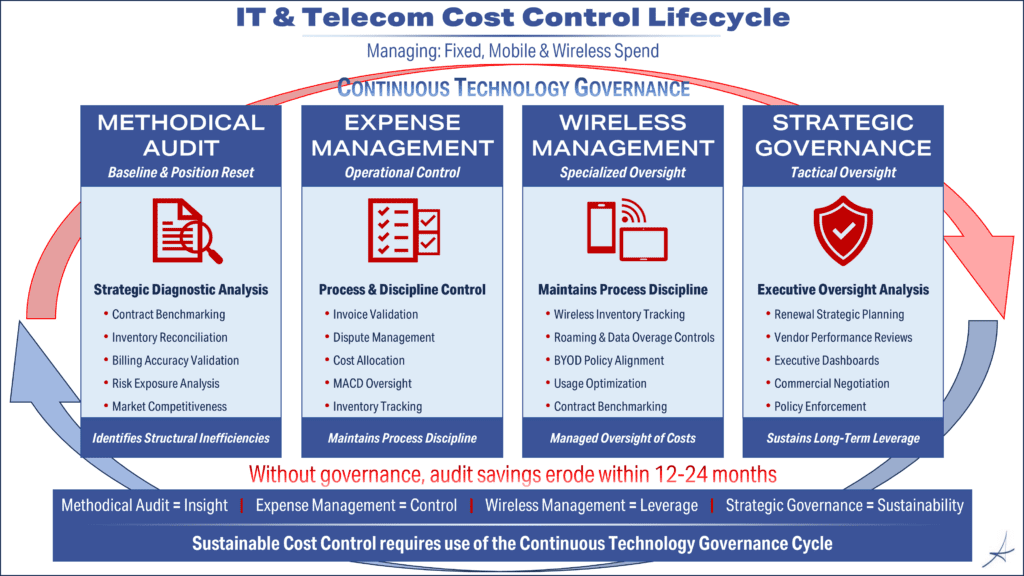
At Abilita, we structure audit and expense management as two components of a broader lifecycle, not standalone services.
True governance means:
- Establishing a defensible commercial baseline
- Benchmarking contracts against market standards
- Structuring negotiation strategies before renewals
- Creating executive visibility into spend drivers
- Integrating wireless, IT, and telecom into a unified governance model
Audit provides insight.
Expense management provides operational control.
Governance ensures neither degrades over time.
A Lifecycle Approach
Phase 1: Diagnostic & Optimization
- Contract benchmarking
- Inventory reconciliation
- Risk identification
- Vendor performance assessment
- Negotiation strategy development
Phase 2: Governance & Sustainment
- Ongoing invoice validation
- Renewal calendar oversight
- Spend analytics by business unit
- Vendor accountability reviews
- Executive reporting
The objective is not just savings — it’s sustained commercial leverage, including wireless services.
Executive Framing: CFO & CIO Perspective
Audit answers: “Are we structurally exposed or inefficient today?”
Expense Management answers: “Are invoices being processed correctly?”
Governance answers: “How do we ensure this environment remains optimized three years from now?”
Wireless services are often the area where oversight gaps are most costly — and governance ensures they are proactively managed.
The Strategic Reality
Technology spend becomes expensive through:
- Contract aging
- Reactive renewals
- Feature creep
- Unmanaged wireless spend
- Lack of executive oversight
Most organizations do not need more software.
They need structured, independent oversight aligned to business outcomes.
That is where advisory-led governance changes the trajectory.
The Bottom Line
Audit is a reset.
Expense management is maintenance.
Governance is strategic control.
Wireless spend amplifies the risk of cost drift.
Organizations that treat technology cost control as a finance function alone will continue to cycle through audits every few years.
Organizations that treat it as a governance discipline, including wireless, create sustained leverage, transparency, and alignment.