

Choosing the Right Technology Advisor
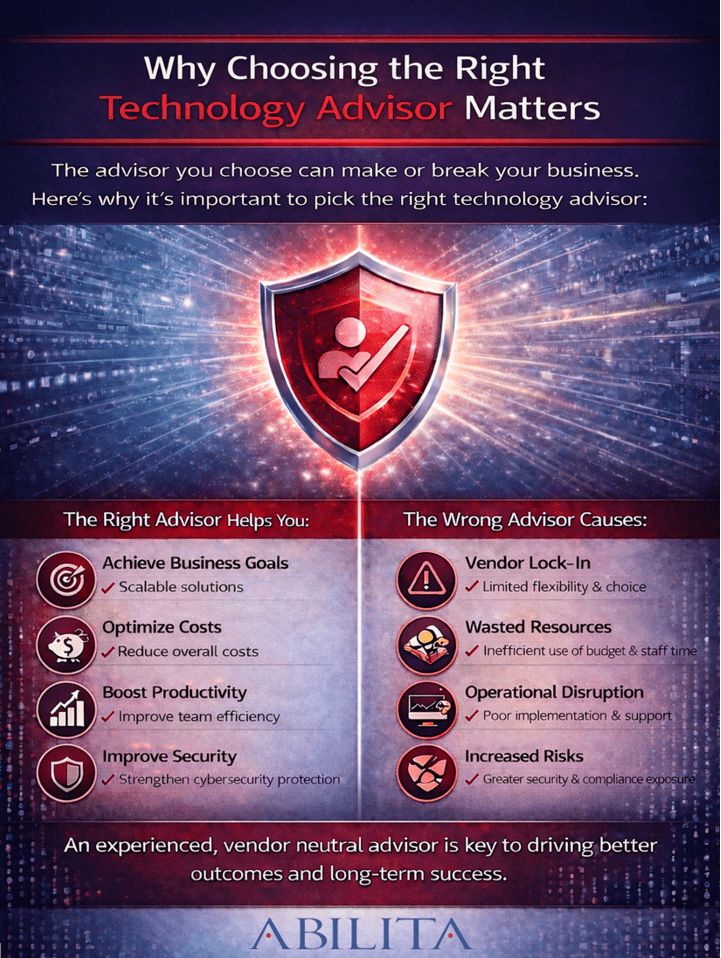
What Sets True Advisors Apart in a Crowded Market
In today’s business environment, leaders have more choices than ever when selecting a technology advisor. Managed service providers, telecom agents, IT consultants, cybersecurity firms, and unified communications providers often promote very similar capabilities:
- Cost optimization
- Technology sourcing
- Vendor management
- Security solutions
- Cloud migration
- Unified communications
- Wireless management
On the surface, many vendors appear to offer the same services and promise similar results. Websites look alike. Proposals sound alike. Sales presentations follow the same script.
Yet outcomes vary dramatically.
The difference is not usually the technology itself — it is the advisory model behind the technology decisions.
Organizations that select the right advisor gain clarity, control, and long-term strategic alignment. Those who choose poorly often end up with fragmented solutions, higher long-term costs, and increased operational burden.
The question for business leaders is simple:
What actually separates one technology advisor from another?
Why Most Technology Advisors Look the Same
The technology services marketplace has become highly commoditized.
Many providers:
- Resell the same vendors
- Offer similar service catalogs
- Use identical industry terminology
- Promise savings or efficiency improvements
- Position themselves as strategic partners
This makes vendor selection difficult.
The challenge is that many providers operate primarily as technology sellers rather than business advisors.
Their business models depend on:
- Product commissions
- Vendor incentives
- Project-driven revenue
- Contract placements
This approach can produce good individual solutions, but it often lacks long-term governance and strategic continuity.
As a result, many organizations accumulate technology decisions that work individually but fail collectively.
Common symptoms include:
- Overlapping solutions
- Aging contracts
- Rising telecom and IT costs
- Wireless plan sprawl
- Vendor management burden
- Reactive decision-making
- Lack of long-term roadmap
The environment is not broken — it is simply ungoverned.
What Businesses Should Look for in a Technology Advisor
The best technology advisors distinguish themselves not by what they sell, but by how they work.
Business leaders evaluating advisors should look for several key characteristics.
1. Business-First Thinking
A true advisor starts with business objectives — not products.
Technology decisions should support:
- Growth plans
- Operational efficiency
- Risk management
- Employee productivity
- Customer experience
An advisor who immediately starts recommending platforms or vendors without understanding business priorities is operating as a seller, not an advisor.
Strong advisors:
- Ask strategic questions
- Seek operational context
- Understand financial priorities
- Align technology with business outcomes
Technology should be the answer to a business problem — never the starting point.
2. Vendor Neutrality and Objectivity
One of the most important differentiators in a technology advisor is objectivity.
Many firms are tied closely to specific vendors or product lines. Even when unintended, these relationships influence recommendations.
Business leaders should ask:
- Are recommendations vendor-neutral?
- How is the advisor compensated?
- Are multiple options evaluated?
- Is the analysis transparent?
An effective advisor provides vendor-neutral guidance that prioritizes the client’s interests over vendor relationships.
Objectivity leads to better long-term decisions.
3. A Structured Advisory Framework
Strong advisors use a repeatable methodology rather than ad-hoc recommendations.
Technology environments are complex and constantly evolving. Without structure, decisions become reactive.
A disciplined advisory approach includes:
Awareness
Understanding the current environment:
- Contracts
- Services
- Vendors
- Costs
- Risks
- Performance
Analysis
Defining the future state:
- Roadmap
- Priorities
- Budget alignment
- Lifecycle planning
Action
Implementing improvements:
- Vendor selection
- Negotiation
- Project coordination
- Implementation oversight
Governance
Managing the environment over time:
- Ongoing optimization
- Contract tracking
- Vendor accountability
- Technology reviews
Without governance, even good decisions degrade over time.
4. Long-Term Partnership Orientation
Technology environments are not static.
Contracts expire.
Vendors change.
Businesses evolve.
Costs shift.
The most effective advisors operate as long-term partners rather than project-based vendors.
They provide:
- Ongoing oversight
- Periodic reviews
- Proactive recommendations
- Lifecycle management
- Continuous improvement
Organizations that rely solely on project-based engagements often find themselves repeatedly starting over.
5. Breadth of Expertise
Technology decisions rarely exist in isolation.
Telecom decisions impact IT.
Wireless impacts security.
Cloud impacts networking.
Unified communications impacts operations.
An effective advisor understands the interdependencies across:
- Telecom services
- IT infrastructure
- Cloud platforms
- Unified communications
- Wireless environments
- Security considerations
Without cross-domain expertise, decisions become fragmented.
6. Practical Execution Capability
Strategy without execution has limited value.
Technology advisors must be able to move from recommendations to results.
This includes:
- RFP development
- Vendor comparisons
- Contract negotiations
- Implementation oversight
- Issue resolution
Business leaders benefit from advisors who stay involved until measurable outcomes are achieved.
What Makes Abilita Different
Abilita was built around a simple principle:
Technology advisory should be structured, objective, and continuous — not transactional.
While many firms focus on selling solutions, Abilita focuses on governing the technology environment.
Advisory First — Technology Second
Abilita’s approach begins with understanding the client’s environment before recommending change.
Engagements typically start with:
- Environment assessment
- Contract evaluation
- Cost analysis
- Risk identification
- Opportunity discovery
This foundation ensures that recommendations are based on facts rather than assumptions.
Vendor-Neutral Guidance
Abilita evaluates technology options based on client needs, not vendor relationships.
Clients receive:
- Objective analysis
- Multiple solution paths
- Transparent comparisons
- Data-driven recommendations
The goal is not to sell a product — it is to help clients make confident decisions.
Structured Governance Model
Abilita provides ongoing lifecycle management rather than isolated projects.
This includes:
Telecom and IT Oversight
- Contract lifecycle tracking
- Vendor performance monitoring
- Renewal strategy
- Spend optimization
Wireless Governance
Wireless environments frequently drift over time.
Abilita provides:
- Plan optimization
- Usage analysis
- Policy alignment
- Inventory visibility
Strategic Planning
- Technology roadmaps
- Budget forecasting
- Risk reduction planning
- Vendor alignment
The result is a technology environment that remains optimized year after year.
Deep Commercial Expertise
Many technology decisions are driven as much by contracts as by technology.
Abilita brings deep expertise in:
- Contract structure
- Pricing models
- Vendor negotiation
- Commercial benchmarking
This often produces significant long-term financial improvement beyond initial savings.
Reduced Internal Workload
Technology environments require constant attention.
Without an advisor, internal teams must manage:
- Vendor meetings
- Contract tracking
- Invoice issues
- Plan changes
- Technology evaluations
Abilita acts as an extension of the internal team, allowing staff to focus on core business priorities.
How to Evaluate Technology Advisors
Business leaders selecting an advisor should ask:
Strategy
- Do they understand our business goals?
- Do they offer a roadmap?
Objectivity
- Are recommendations vendor-neutral?
- How are they compensated?
Methodology
- Do they have a structured process?
- What happens after implementation?
Experience
- Have they managed environments like ours?
- Do they understand telecom and IT?
Continuity
- Will they stay involved long-term?
- Do they provide governance?
The answers to these questions often reveal whether a firm is a technology seller or a true advisor.
The Real Value of a Technology Advisor
The right advisor delivers more than cost savings or technology upgrades.
They provide:
- Better decisions
- Reduced risk
- Improved vendor accountability
- Controlled technology growth
- Strategic clarity
Most importantly, they ensure that technology remains aligned with business priorities over time.
Conclusion
Technology choices have never been more abundant, and the number of firms offering technology advisory services continues to grow.
But not all advisors operate the same way.
The organizations that achieve the best outcomes typically work with advisors who provide:
- Business-aligned strategy
- Independent guidance
- Structured methodology
- Long-term governance
- Practical execution
Abilita’s advisory model is designed around these principles.
Instead of focusing on individual projects or product placements, Abilita helps organizations create and maintain a well-governed technology environment that supports long-term business success.